
The Smoke You See from 100 Kilometers Away
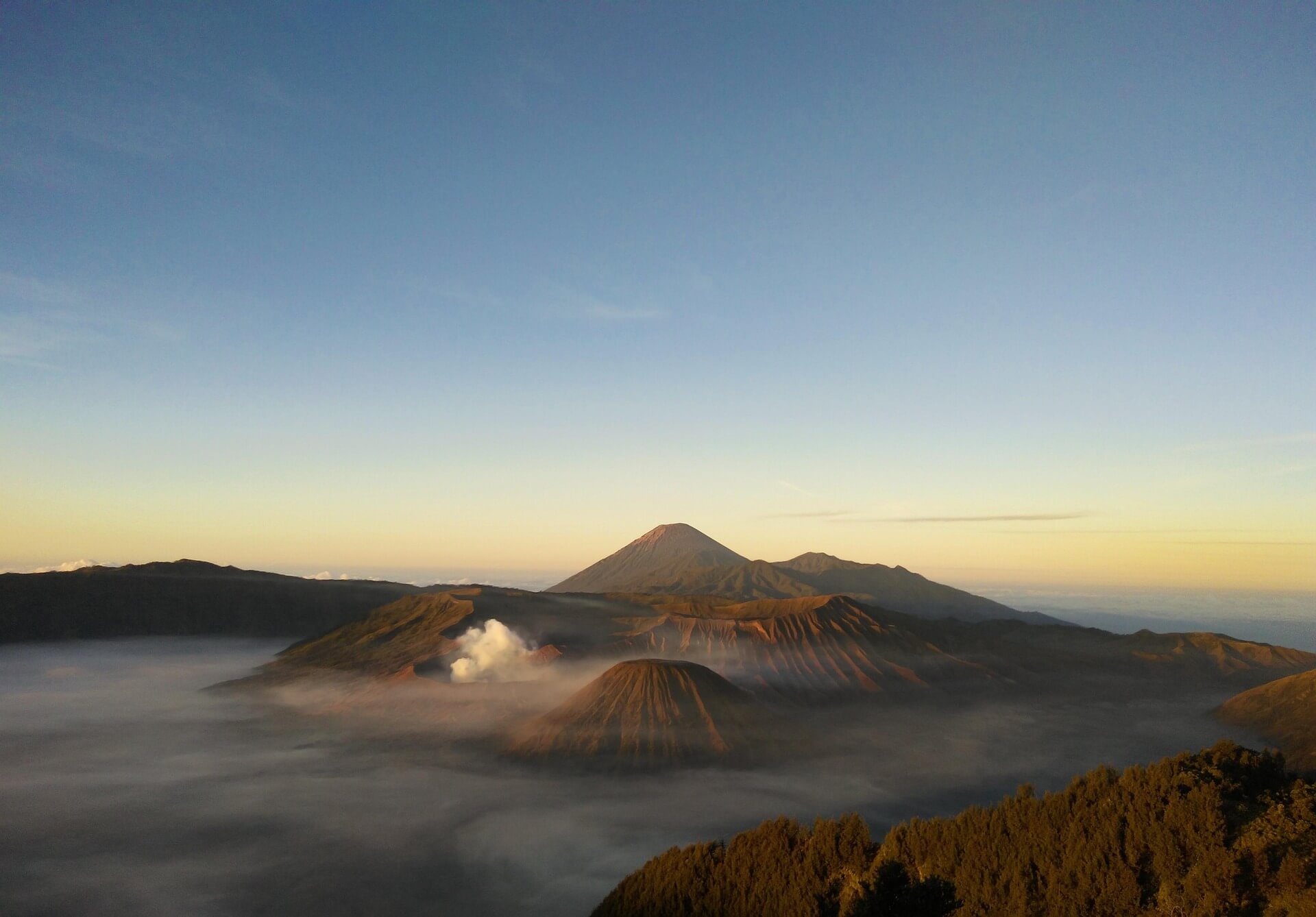
There is a moment, somewhere on the road between Surabaya and Probolinggo, when you glance toward the horizon and realize that the smudge against the sky isn’t a cloud. It’s too steady. Too pale. Too vertical. It’s Mount Bromo, exhaling.
Even at that distance, before you’ve committed to the early wake-up, the cold, or the jeep, there’s already something in that plume that demands attention. It belongs to a landscape that humans have been watching — and living beside, and worshipping — for centuries. That context is what most Bromo articles miss. They’ll tell you what time to set your alarm. They rarely tell you why this mountain has been considered sacred since the 9th century, why a Hindu community of descendants of the Majapahit Empire still throws offerings into its crater, and why, geologically speaking, what you’re looking at is one of the most dramatic volcanic calderas on the planet.
This guide covers all of it: the geology that formed the landscape, the Tengger culture that shaped its meaning, the logistics that will get you there, and the honest sensory experience of standing at the crater rim when the sun hasn’t risen yet and the temperature is somewhere near freezing and you can smell sulfur drifting across the sand.
- Facebook
- Twitter
- Pinterest
The Geology Behind the Landscape
Most people arrive at Bromo focused on the volcano in front of them. But what they’re actually standing inside — without always realizing it — is something far larger: the remnants of a catastrophic eruption that happened approximately 45,000 years ago, one comparable in scale to the eruption that created Krakatau.
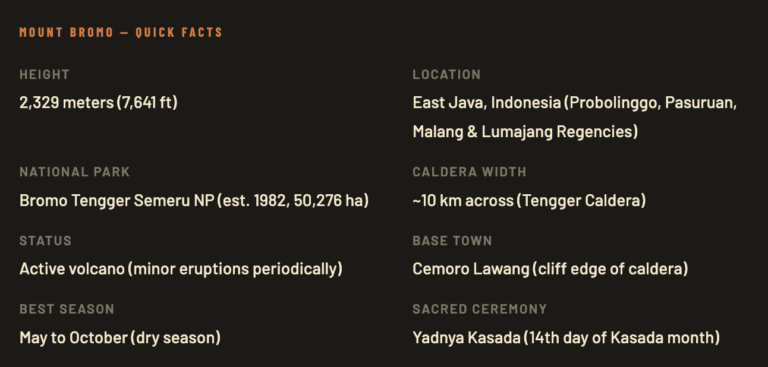
That ancient eruption hollowed out what geologists now call the Tengger Caldera, a near-circular depression roughly 10 kilometers across, with rim walls rising 200 to 600 meters above the floor. The sand floor you drive across today — the one that looks like a moonscape, flat and grey-brown and somehow foreign to Java’s otherwise lush topography — is what remains of the volcanic ash and lava that filled the caldera afterward. Locals call it the Lautan Pasir, the Sea of Sand.
Within this ancient caldera, a new generation of volcanic activity created five additional cones: Mount Bromo (2,329 m), Mount Batok (2,470 m), Mount Kursi (2,581 m), Mount Watangan (2,661 m), and Mount Widodaren (2,650 m). Of these, only Bromo remains active. Mount Batok — the perfectly ridged cone that sits so close to Bromo it looks like a twin — is entirely dormant, its lower slopes colonized by casuarina trees that somehow find purchase in the volcanic ash.

- Facebook
- Twitter
- Pinterest
- Facebook
- Twitter
- Pinterest
- Facebook
- Twitter
- Pinterest
- Facebook
- Twitter
- Pinterest
- Facebook
- Twitter
- Pinterest
The Tengger People: Hinduism Above the Clouds
One thing that takes many visitors completely by surprise is that the communities living on the slopes of Mount Bromo are Hindu — not Muslim, which is the dominant religion across the rest of Java and Indonesia as a whole.
The explanation runs back to the 13th century. The Tenggerese are widely believed to be descendants of the aristocracy of the Majapahit Empire, the powerful Hindu-Buddhist kingdom that once ruled much of maritime Southeast Asia from its capital in East Java. When the Majapahit Empire fell in the late 15th and early 16th centuries, a significant portion of its Hindu-Brahmin population fled to two highland refuges: the cliffs of Bali, and the volcanic uplands of the Tengger massif.
The Tenggerese have inhabited the mountain area since approximately the 9th century AD. Today, scattered across numerous villages on the slopes — including Ngadisari, Cemoro Lawang, and Wonokitri — they practice a form of Hinduism fused with elements of Animism and Mahayana Buddhism, worshipping Ida Sang Hyang Widi Wasa (the Almighty God) alongside the Trimurti gods of Brahma, Shiva, and Vishnu. Their spiritual relationship with Bromo is not decorative. The mountain is, for them, the home of the mountain deity — and it must be honored, sustained, and given offerings, or the volcanic earth could reclaim what it has always owned.
- Facebook
- Twitter
- Pinterest
- Facebook
- Twitter
- Pinterest
- Facebook
- Twitter
- Pinterest
- Facebook
- Twitter
- Pinterest
- Facebook
- Twitter
- Pinterest
The Sunrise Experience — What It Actually Feels Like
Let’s be honest about what the Bromo sunrise experience involves, because every travel photo lies about it slightly.
Your jeep picks you up between 1 AM and 3 AM, depending on where you’re staying and which viewpoint you’ve chosen. The road up to Penanjakan in December is dusty; in the rainy season it’s a mud chute. The jeep is cold. You’re sitting with strangers, sharing a flask of instant coffee someone poured into a plastic cup at the guesthouse, the engine grinding up a switchback road in the dark.
At Penanjakan 1, if it’s a weekend in July, you will find that several hundred people have already arrived and claimed the best spots on the viewing platform. You stand behind them. The air at 2,770 meters is somewhere between 3°C and 8°C. The people who came unprepared for this temperature are visibly suffering. The people who brought a proper fleece, gloves, and a hat are still cold, but functionally comfortable.
Then, at around 5:20 AM in the dry season, something starts to shift in the eastern sky. It’s not a dramatic instant — it’s a slow bleed of color. Purple gives way to blue, blue gives way to amber, amber becomes orange, and there’s a moment, maybe two minutes long, when the entire caldera below is lit in gold. Mount Bromo is smoking. Mount Batok’s ridges catch the light at an angle that makes it look like a painting. And in the distance, if it’s a clear morning, Mount Semeru — Java’s highest peak at 3,676 meters — puffs a small eruption on the horizon, right on schedule. Semeru erupts approximately every 20 to 30 minutes. It’s been doing this for years.
Yadnya Kasada: The Ceremony That Defines Bromo
Once a year, everything changes at Mount Bromo. The usual population of tourists in down jackets giving way to thousands of Tenggerese devotees making a pilgrimage that has continued without interruption for generations — through volcanic eruptions, political upheaval, pandemic. It happens on the 14th day of the Kasada month in the traditional Hindu lunar calendar, which typically falls between June and July in the Gregorian calendar. It is called Yadnya Kasada, or simply Kesodo.
The ritual begins a full month before the ceremony date. Tenggerese from villages scattered across the caldera rim gather at the Luhur Poten temple — a low, open-air Hindu temple constructed in the Sea of Sand itself, roughly 300 meters from the base of Bromo’s cone. The temple is built in a distinctive black stone Balinese-influenced architectural style, surrounded by the ashen floor of the caldera. On the night before the main ceremony, devotees pray, receive drops of holy water collected from a sacred cave inside Mount Widodaren, and perform offerings of gamelan music and traditional dance, including the Roro Anteng and Joko Seger dance-drama that retells the founding legend.
On the morning of Yadnya Kasada itself, long before sunrise, the crowds who have gathered at Luhur Poten climb the 250 steps to the crater rim. There they throw their offerings — vegetables, fruit, flowers, chickens, goats, and money — directly into the crater. The atmosphere is unlike anything the park sees during normal operations: torch-lit processions, the sound of prayer and chanting, the smell of incense mixing with volcanic sulfur.
There is one detail that strikes nearly every visitor who witnesses the ceremony: some people climb down into the volcano itself to retrieve the thrown offerings, catching them in nets before they reach the hot bottom. This isn’t desecration. It is considered an act of faith — the items caught from the volcano are believed to carry its blessing and bring good fortune.
For travelers, it’s important to know that during Yadnya Kasada, the park is typically closed to general tourism. The volcano belongs to the Tenggerese for that period. Attempting to treat the ceremony as a background photo opportunity would be both disrespectful and likely to result in being turned away. However, villages like Cemoro Lawang remain accessible, and witnessing the spirit of the event from the periphery — the processions, the music, the atmosphere — is possible with respectful distance.
- Facebook
- Twitter
- Pinterest
- Facebook
- Twitter
- Pinterest
- Facebook
- Twitter
- Pinterest
- Facebook
- Twitter
- Pinterest
- Facebook
- Twitter
- Pinterest
The Best Sunrise Viewpoints Ranked
Penanjakan 1 (Gunung Penanjakan) — The Classic Panorama
The highest accessible point on the caldera rim, sitting at approximately 2,770 meters above sea level. This is the viewpoint responsible for every “postcard” image of Bromo: the full panorama showing the sea of mist in the caldera below, Bromo’s cone with its smoke, Batok’s perfectly ridged outline, and Semeru on the far horizon. Penanjakan 1 is the best choice for first-time visitors who want the complete compositional picture. The trade-off is crowds — it’s the most popular viewpoint, and arriving after 4 AM on a weekend means fighting for space. Aim to be there by 3:30 AM at the latest.
Kingkong Hill — The Photographer’s Choice
Located slightly below Penanjakan 1 on the same ridge, Kingkong Hill has earned a strong reputation among photographers as the superior compositional option. The angle brings Bromo and Batok closer together in the frame, creating a more intimate and balanced image. Crowds are significantly lighter than Penanjakan 1. The viewpoint takes its name from a rock formation on the cliffside that resembles the profile of a great ape when viewed from below — a quirky detail that becomes obvious once pointed out. Access requires a jeep and a moderate uphill walk in the dark.
Seruni Point (Penanjakan 2) — The Accessible Option
Seruni Point was developed as an overflow relief for Penanjakan 1, and it works well. Sitting at around 2,400 meters, the view is somewhat lower and slightly less expansive, but the infrastructure is better — proper platforms, safety railings, and a staircase. Particularly good for families, older visitors, or travelers arriving without a private jeep, as it sits within walking distance (30–45 minutes uphill) from Cemoro Lawang. It’s also sometimes called the “Great Wall of Bromo” due to its long viewing terrace built across the ridge.
Bukit Cinta (Love Hill) — The Intimate View
At 2,680 meters and positioned differently along the Pananjakan ridge, Love Hill offers a perspective that makes Bromo’s cone look larger and more commanding than it does from the higher panoramic points. It’s notably quieter than Penanjakan 1 and is a popular choice for pre-wedding photo sessions — a decidedly Indonesian tradition that you may encounter on any morning visit. The name is entirely literal: this is considered a romantic viewpoint.
Mentigen Hill — For Milky Way and Camping
The viewpoint nearest to the Ngadisari rest area and accessible on foot from the road, making it the most budget-friendly option for those without jeeps. The elevation is lower, which affects the sunrise composition, but Mentigen Hill’s real advantage is the night sky. Clear nights here offer a direct view of the Milky Way above the caldera. It’s a popular camping spot for visitors who want to be in position for sunrise without the 3 AM jeep rush.
- Facebook
- Twitter
- Pinterest
- Facebook
- Twitter
- Pinterest
- Facebook
- Twitter
- Pinterest
- Facebook
- Twitter
- Pinterest
- Facebook
- Twitter
- Pinterest
Walking the Sea of Sand and Climbing the Crater
After the sunrise — and most people, once the light softens, find their energy returning — comes the part of Bromo that the photographs underrepresent: crossing the Sand Sea on foot.
From Cemoro Lawang, the path down into the caldera takes about 45 minutes on foot to reach the base of Bromo’s cone. The terrain is disorienting in a productive way. You’re walking across a flat grey-brown landscape ringed by steep volcanic walls. The scale is difficult to process. There are almost no visual reference points to calibrate against until you’re already deep in, and then you turn around and the rim above you looks impossibly far away.
Horses are available at the jeep parking area inside the caldera. A horse ride to the base of Bromo’s staircase costs approximately IDR 200,000 one-way. It’s optional — perfectly fit adults can walk the 30 or so minutes across the sand — but horses are a practical option for visitors with mobility concerns or those managing young children.
The 250 concrete steps to the crater rim are more strenuous than they appear in photos, partly because of the altitude and partly because the sulfur fumes become noticeably stronger as you ascend. At the rim, you are standing at the edge of an active volcanic vent. The crater is roughly 800 meters wide and 200 meters deep. There is no lava visible. There is smoke — thick, white, churning — rising from the center, and a smell that the travel blogs consistently describe as “rotten eggs.” That description is accurate. Sulfur dioxide has a chemical fingerprint that is genuinely unpleasant, and depending on wind direction, it can be quite strong at the rim. A light scarf or dust mask is useful.
Before you reach the staircase, pause at the Luhur Poten temple. It sits directly on the sand floor, approximately 300 meters before the base of the mountain — a black-stone Hindu shrine with the unmistakable architecture of a Balinese temple, rising improbably from the volcanic plain. It’s open to respectful visitors. Understanding that this temple is not a tourist attraction but an active place of worship — visited daily by Tenggerese devotees for prayer and offerings — transforms the experience of the entire site.
- Facebook
- Twitter
- Pinterest
- Facebook
- Twitter
- Pinterest
- Facebook
- Twitter
- Pinterest
- Facebook
- Twitter
- Pinterest
- Facebook
- Twitter
- Pinterest
Getting There?
Bromo is accessed primarily through two gateway cities: Probolinggo (the more popular and budget-friendly route, with the most accommodation options in Cemoro Lawang) and Malang (a more scenic approach through the savanna and southern caldera, preferred by those doing a combined Bromo-to-Ijen journey). Both cities are accessible by train or bus from Surabaya, East Java’s capital and the site of Juanda International Airport.
From Probolinggo, the drive to Cemoro Lawang takes approximately 1.5 hours by shared minibus (bemo) or private vehicle. The bemo departs from Terminal Bayuangga and requires 14 passengers before it leaves — which can mean a long wait. Renting a scooter or arranging a private driver from Probolinggo is a significantly more reliable option.
From Surabaya, the total journey to Cemoro Lawang takes approximately 3–4 hours. Many travelers arrange a full-day tour directly from Surabaya, departing around midnight to arrive in time for sunrise. From Malang, the journey is approximately 2–3 hours via the southern route, which passes through highland villages and agricultural terraces before descending into the caldera’s southern approach.
Getting Around Inside the Park
Only 4WD jeeps (hardtop Land Cruisers) are permitted inside the national park for accessing the sunrise viewpoints. Personal vehicles must stop at Cemoro Lawang. Jeep tours are available directly in Cemoro Lawang and accommodate up to 5 passengers per vehicle. The cost is shared between passengers, which significantly reduces individual costs when traveling in a group.
Where to Stay
The primary base is Cemoro Lawang, the village that sits on the caldera rim. Accommodations range from basic homestays to simple hotels with caldera views. Budget travelers consistently recommend Cahyo Homestay Bromo for its cleanliness and central location. Cemara Indah Hotel occupies one of the best positions on the rim, with rooms facing the caldera directly — you’re paying for a view that justifies the premium. ARTOTEL Cabin Bromo offers a design-forward experience for travelers who want something beyond basic. During peak season (July-August and Indonesian public holidays), accommodations near the main viewpoints sell out days in advance. Book early.

0 Comments